E
— Edwards, Philip, Threshold of a Nation: A Study in English and Irish Drama (Cambridge: Cambridge University Press, 1979). Edwards was the external examiner for my Oxford DPhil. a few months after this book appeared. I returned to it for my paper on Yeats and Shakespeare at the Shakespeare and Ireland event organised by Andy Murphy at Trinity College, Dublin in April 2023.
— [Elizabeth 1] Speeches Delivered to Queen Elizabeth, on her Visit to Giles Brydges, Lord Chandos, at Sudeley Castle, in Gloucestershire, ed. Sir Egerton Brydges (Printed at the Private Press of Lee Priory; By Johnson and Warwick, 1815). 4to. A second title page advertises this as the tenth work, in quarto, printed at the Lee Priory press, and in an impression limited to 100 copies. List of the works hitherto printed at Lee Priory on the final leaf. Contemporary half morocco with marbled boards.
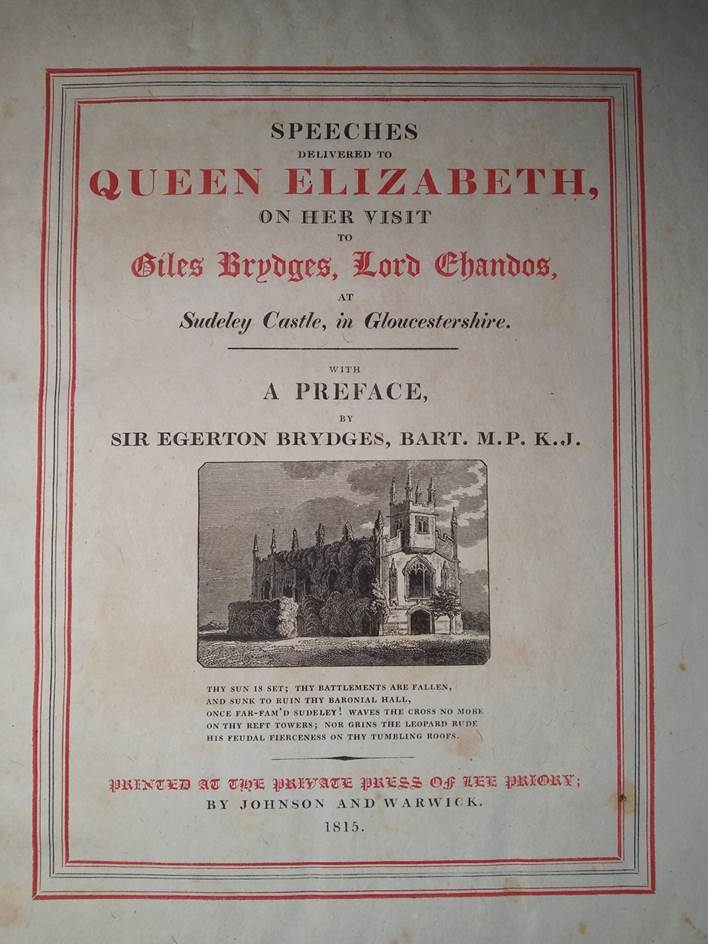
Title page from the Lee Priory Speeches to Elizabeth (1815)
— [Elizabeth I] Gloriana’s Glass. Compiled by Alan Glover. With a Wood-Engraving by Joan Hassall. Queen Elizabeth 1 reflected in verses and dedications addressed to her, reports concerning her, and her own words written & spoken. The Nonesuch Press in the year of the coronation of Queen Elizabeth II [London, 1953].
— Erasmus, Desiderius, Moriae Encomium: or The Praise of Folly. Made English from the Latin of Erasmus by W. Kennet…Adorn’d with Forty-eight Copper Plates, including the Effigies of Erasmus and Sir Thomas More…To which is prefix’d A Preface by the Translator, and divers copies of Commendatory Verses. The Fifth Edition. (London: J. Wilford, 1735). Full brown leather with black title label lettered in gold on spine and gold borders to front and back covers. Marbled endpapers. Double frontispiece of Erasmus and More. The engravings in this edition are based on pen and ink drawings by Hans Holbein the Younger in a copy of the Basel edition of 1515/16. Contains subject index. Bookplate and signature of Lt-Col. Dales.

From Erasmus, Praise of Folly, trans. White Kennett (1735)
White Kennett originally published his translation of Praise of Folly in 1683 when he was a student at St Edmund Hall, Oxford, with the title Wit against Wisdom: or a Panegyric upon Folly. The Holbein engravings were not introduced until 1722, when the title had been adjusted to Wit against Wisdom; or, the praise of folly. By 1735 ‘Wit against Wisdom’ had been dropped altogether. Kennett later became Bishop of Peterborough.
Related titles: Moriae encomium (Basel: Froben, 1522), Typ SwB.B22FE; The Praise of Folie, trans. Thomas Chaloner (1549 [i.e. 1557?]), Typ BL.B57PE; Sebastian Brant, Navis stultifera (Basle: Nicolaus Iamparter, 1506), TypSwB.B06LB; Sebastian Brant, Stultifera navis (London: John Cawood, 1570), Typ BL.B70CB.
— Estienne, Charles, Maison Rustique, or The Countrie Farme. Compiled in the French tongue by Charles Stevens and John Liebault doctors of Physicke. And translated into English by Richard at Practitioner of Physicke (London: Printed by Edmund Bollifant for Bonham Norton, 1600). STC 10547. Large 8vo. Rebound in later full calf with gilt rules. 20 full page illustrations of garden designs from what look like Celtic knots to labyrinths; 16 smaller illustrations of plants and tools. 1st English edition.
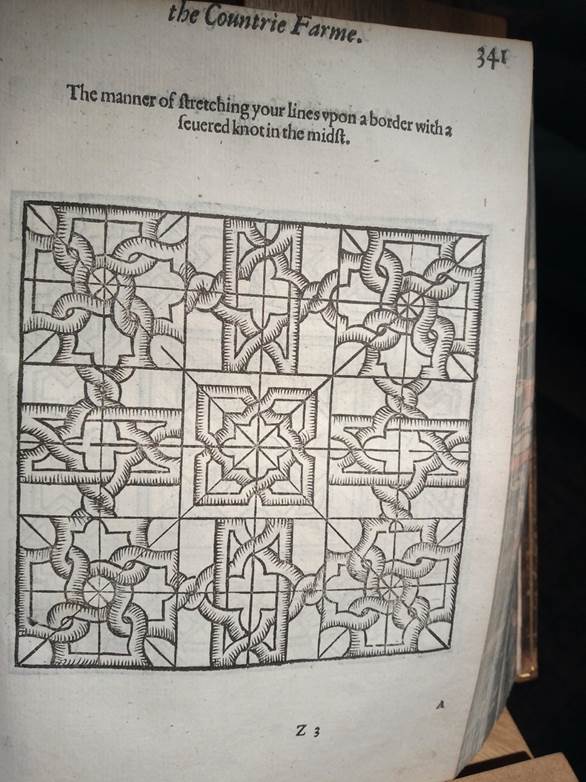
Garden Design for Estienne’s Countrie Farme (1600)
Estienne’s work was the most important book on husbandry to be published during the sixteenth century. First published in Latin as Praedium rusticum in 1554, and then in a French language edition in 1564. The 1600 English translation was reissued in 1606, and a revised English edition by Gervase Markham was published in 1616. This aimed to reconcile the methods of husbandry described in the French, Italian and Spanish editions with English practice.
Related titles: see ‘Ecology’ in the Topic Index; also Charles Estienne, Sylva, Fruteum, Collis bound with Arbustum, Funiculus, Spinetum, TypFP.B38SE
— Euripides, Euripides poeta tragicorum princeps, in Latinum sermonem conversus, adiecto eregione textu Graeco (Basel: Johann Oporinus [1562]). Folio. Full contemporary vellum. Printer’s device showing Arion on a dolphin playing a lyre. Text in double columns of Latin and Greek. Extensive topic and phrasal index in Latin at the end. USTC 654877.

Title page from Stiblinus’s Euripides (1562)
This is the first collected edition of Euripides to be printed with Latin translations and annotation, prepared by Gasparus Stiblinus (Kaspar Stiblin, Amtzell, 1526-63). The edition includes all nineteen of Euripides’ tragedies. Each one is followed by Stblinus’s detailed notes; there is a life of Euripides by Jacob Micyllus (Strasbourg, 1503?-1558) and there are further notes to eleven tragedies by Jean Brodeau (Tours, c. 1500-1573). There are English versions of some of the prefaces and plot summaries for individual tragedies in an online resource hosted by the Classics department at the University of California, Berkeley.
The first serious attempt to establish that Shakespeare may have known Euripides in Latin translation (and in particular that Titus Andronicus is modelled on Hecuba) was by Emrys Jones in The Origins of Shakespeare (1977), which cites Stiblinus.
Related titles: Typ GHB97.CE Euripidis tragoediae XIX, 2 vols. (Heidelberg, 1597)
Copies recorded in UK libraries: British Library (2); Cambridge: Trinity College; Glasgow University; Oxford: Bodleian; Magdalen, Merton and Queens colleges.