F
— Fanshawe, Richard, Il Pastor Fido The faithfull Shepheard with An addition of divers other Poems Concluding with a short Discourse of the long Civill Warres of Rome (London: Printed for Humphrey Moseley, and are to be sold at his Shop at the Princes Armes in S. Pauls Church-yard, 1648). Later three-quarters calf and marbled boards. Small 4to. Wing G2175; ESTC R14976.
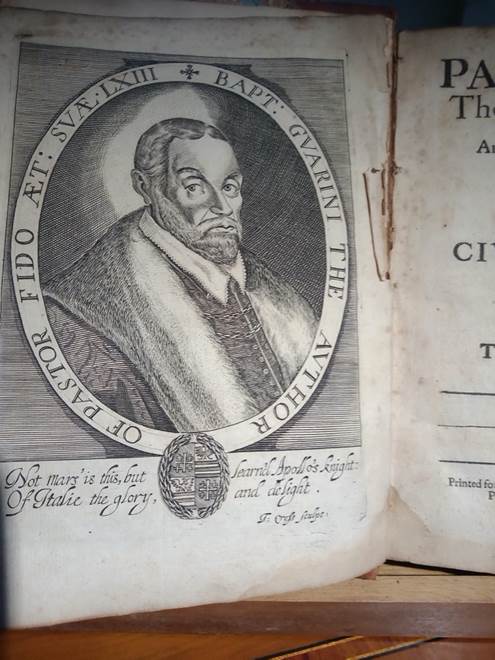
Portrait frontispiece of Guarini from the 1648 edition of Fanshawe’s Il Pastor Fido
This is a reissue of the complete text of the 1647 edition of Il Pastor Fido with the addition of previously unpublished original poems and translations, including Aeneid IV (for which Fanshawe uses the Spenserian stanza rather than iambic pentameter). This uses the sheets of the 1647 edition, continuing the pagination. The collection was reprinted in 1664, 1676 and 1692, but none of these reissues is of textual significance. Fanshawe’s editor, Peter Davidson, notes that there are numerous copies of the 1648 poems in earlier manuscripts, but that no copy of the printed text has been found with any contemporary annotation or correction. He also reports that Fanshawe did not see this edition through the press and that it was rather carelessly printed.
The collection focusses on the role of the young prince of Wales in the renewal of a fractured nation, aligning him both with Virgil’s exiled Aeneas and Guarini’s shepherd kings. There is an additional dedication to the 1648 edition which addresses Charles as ‘The HOPE AND LUSTRE : Of Three Kingdomes’ and the volume reprints the 1647 dedication, which describes the Guarini translation as ‘a Lantskip of these kingdoms’.
See also Guarini 1647; Booksellers’ and Auction Catalogues: Edwards (List 69, no. 29)
Related titles: Ann Fanshawe, Memoirs of Lady Fanshawe, Wife of the Right Hon. Sir Richard Fanshawe (1829), s DA391.IF2F29
— Fletcher, Giles. See Fletcher, Phineas and Giles 1783
— Fletcher, John, Bonduca: A Tragedy (1711). Disbound. Engraved frontispiece. The play was first printed in the Beaumont and Fletcher folio of 1647, but was probably written by Fletcher alone and performed by the King’s Men c. 1613. The present text appears to be taken from The Works of Mr. Francis Beaumont and Mr. John Fletcher, vol. 6, printed for Jacob Tonson, 1711. ESTC T13898. Like Locrine this is a ‘British’ play (Bonduca is Boudica) with echoes of Tamburlaine.
See also John Fletcher, Bonduca, prepared by Walter Wilson Greg [Malone Society] (London: Oxford University Press, 1951).
— Fletcher, John, The Island Princess. A Tragicomedy. From The Works of Mr Francis Beaumont, and Mr. John Fletcher; in ten volumes (London: Jacob Tonson, 1711). Engraved frontispiece. ESTC T179167.
The play was first performed in 1621 by the King’s Men and first printed in the Beaumont and Fletcher first folio of 1647, though it is acknowledged to be the solo work of Fletcher.
See also John Fletcher, The Island Princess, ed. Clare McManus (London: Arden Shakespeare, 2013)
—Fletcher, John, The Chances. A Comedy. As it is acted at the Theatre-Royal. By his Grace the Duke of Buckingham (London. Printed for W. Feales, R. Wellington, C. Corbett, J. Brindley, A. Bettesworth and F. Clay, 1735. Engraved frontispiece. Title in red and black. 3 pages of advertisements. 12mo. T59587.
Fletcher’s play was probably first performed in 1617 and first printed in the Beaumont and Fletcher first folio of 1647, though the prologue assigns it to Fletcher alone. It was revised by George Villiers, Duke of Buckingham, for performance at the Bridges Street Theatre on 5 February 1667 and this version was frequently restaged and printed throughout the eighteenth century. There was a further adaptation by Garrick in 1773.
Related items: The Chances (Bell’s Edition, vol. 15, 1777), s PR1241.B4D77;The Royal Merchant: or Beggars-Bush (1706?), r PR2430.R6D06; Philaster [Bell’s edition] (1778), s PR1241.B4D77; Rule a Wife and Have a Wife (1781), s PR1241.B4D77.
— Fletcher, Phineas, The Purple Island, or The Isle of Man: Together with Piscatorie Eclogs and other Poeticall Miscellanies (Printed by the Printers to the Universitie of Cambridge, 1633). Separate title page for Piscatorie Eclogs with new run of signatures. A further title page with woodcut design for Elisa, or An Elegie upon the Unripe Decease of St Antonie Irby, but with signatures running continuously from the Eclogs. Title page printed in red and black within typographic border with woodcut device, woodcut initials, head- and tail-pieces. Nineteenth-century calf, rebacked. Ms note on the title page identifies Fletcher as the Rector of Hilgay in Norfolk. R4 which carries the commendatory poem by Francis Quarles is bound in after the title page of Poetical Miscellanies and gatherings M and N are transposed. Ownership inscription on ffep ‘Edward Thurlow the Eve of the first Monday in August 1804’; Armorial bookplate of Thomas Weld-Blundell on front pastedown. 1st edition. Small 4to. STC 11082.
See also Booksellers’ and Auction Catalogues: Edwards (List 77, no. 43) on a large paper copy.
Copies in other UK libraries: British Library; Cambridge University Library; Edinburgh University Library; Salisbury Cathedral.
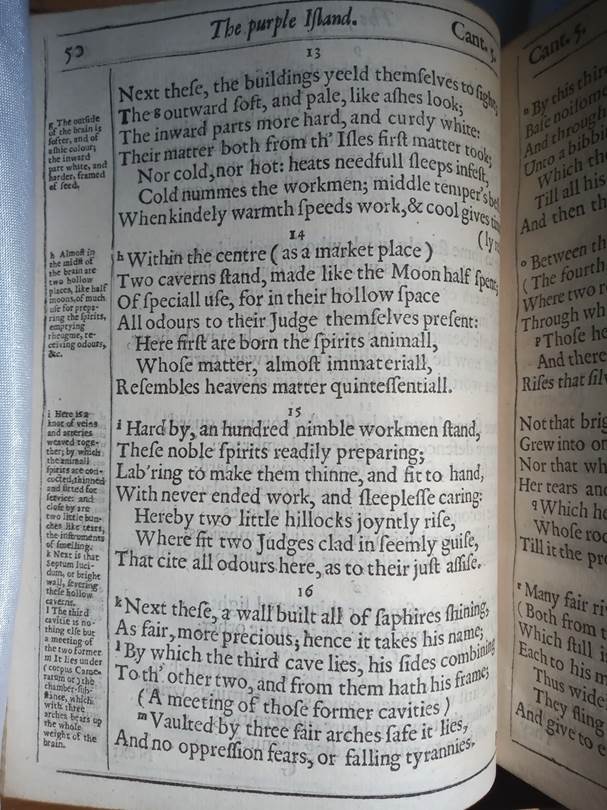
From Fletcher’s The Purple Island (1633)
Phineas was the son of Giles Fletcher and the brother of Giles the younger, both also poets. Fletcher is consciously Spenserian (Quarles calls him ‘the Spencer of this age’) and he is probably the author of the erotic poem Brittain’s Ida, which was printed as Spenser’s work in 1628 (see Spenser 1679). The printed marginal notes for The Purple Island present a running commentary on the human anatomy. There is a very good discussion of the poem in Jonathan Sawday’s The Body Emblazoned (1995).
— Fletcher, Phineas, Piscatory Eclogues, with other Poetical Miscellanies. By Phinehas Fletcher. Illustrated with Notes, Critical and Explanatory (Edinburgh: Printed for A. Kincaid and W. Creech; and T. Cadell in the Strand, London, 1771). Full calf with panelled ornaments on spine in blind. Edited by Alexander Fraser Tytler Woodhouselee with an Introduction and index to the notes. Bookplate of Alan John Jarvis on front pastedown. ETSC T139677.

— Fletcher, Phineas and Giles, The Purple Island. Or the Isle of Man. An Allegorical Poem. By Phineas Fletcher, Esteemed the Spenser of his age. To which is added, Christs Victory and Triumph. A Poem, in Four Parts. By Giles Fletcher. A new edition, Corrected and revised, with additional Notes by the Editor (London: Printed by Frys and Couchman, 1783). Ownership inscription of L. V. Lees [?], Corpus Christi College, Cambridge. Both Moses Browne and Peregrine Branwhite have been identified as the editor. ESTC T062859.
See Earl R. Wasserman, ‘Moses Browne and the 1783 edition of Giles and Phineas Fletcher’, Modern Language Notes 56.4 (1941); Booksellers’ and Auction Catalogues: Edwards (List 74, no. 6), for Branwhite.
— Ford, John, The Chronicle History of Perkin Warbeck. A Tragedy. A Strange Truth (London: Printed for J. Roberts at the Oxford Arms, in Warwick-Lane, 1714). Frontispiece portrait. 12mo. ESTC T57008.
This is the second edition of the play which T. S. Eliot saw as ‘unquestionably Ford’s highest achievement’, the first having appeared in 1634. It is prefaced by ‘An Historical Account of the Rise, Rebellion, Abettors, Progress, Imprisonment, and Execution of Perkin Warbeck’, which does not appear in the 1634 edition. This is distinct from Thomas Gainsford’s The True and Wonderful History of Perkin Warbeck (1618). The play was revived in 1745 at Goodman’s Fields during Bonnie Prince Charlie’s invasion of England. The prompt copy for this performance (now in the Bodleian) was based on a copy of the 1714 edition with various alterations designed to inspire patriotic, anti-Jacobite feeling.
Related titles: The Dramatic Works of John Ford, ed. Gifford, 2 vols. (1827), s PR2520.E27
— Fowler, Alastair, The Mind of the Book: Pictorial Title Pages (Oxford: Oxford University Press, 2017)